“The leadership blueprint has shifted: flexibility is no longer a perk, but a prerequisite. Today’s market leaders win by weaving autonomy and equity into the very fabric of their high-performance cultures.”
In 2026, the conversation around Diversity, Equity, and Inclusion (DEI) has moved past the era of bold slogans and into the era of strategic resilience. The noise of previous years has evolved into a disciplined focus on systems, signals, and substance. Companies are no longer just asking “How diverse are we?” but “How fair are our systems, and how measurable is our impact?” This article explores the frameworks, tools, and cultural shifts defining DEI in 2026.
The 2026 DEI Framework: From “People” to “Systems”
In the current landscape, the most successful companies have adopted an Inclusion-by-Design framework. Rather than treating DEI as a separate HR project, it is embedded into the “bones” of organizational processes.
Key Pillars of Modern Frameworks
Algorithmic Accountability
With AI managing everything from resume screening to performance reviews, 2026 frameworks prioritize “bias audits” to ensure technology doesn’t quietly reverse equity gains.
Intersectional Operations
Moving beyond single-identity metrics (e.g., just “gender”), companies now track how overlapping identities (like neurodivergence, caregiving status, and ethnicity) impact the employee experience.
“Quiet Commitment” Model
To avoid performative backlash, many firms are rebranding DEI as “Organizational Health” or “Operational Fairness,” focusing on results rather than rhetoric.
The Evolution of DEI Measurement Focus
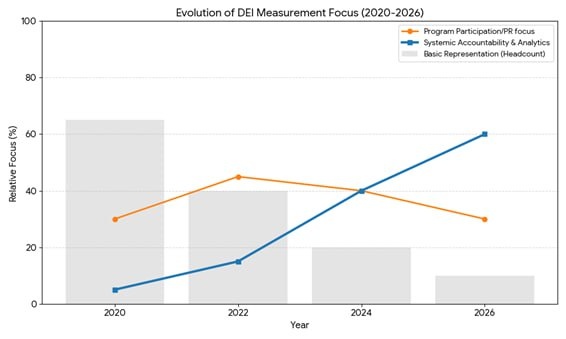
The evolution of DEI measurement between 2020 and 2026 reflects a fundamental shift in how organizations define success:
- The Decline of “Headcount-Only” Metrics: The emphasis on basic representation has dropped from a dominant 65% in 2020 to just 10% in 2026. Companies have realized that simply “counting people” is insufficient without addressing the underlying systems.
- The Rise of Systemic Accountability: Strategic focus on advanced analytics and systemic accountability has surged from 5% in 2020 to 60% in 2026. This reflects the adoption of tools for pay equity, promotion velocity, and bias audits.
- The Plateau of “Performative” Programs: Participation in general DEI programs and public relations efforts peaked between 2022 and 2024 but has stabilized as organizations move toward more integrated, business-aligned strategies.
Key Insight: 2026 is the year of depth over breadth. Leaders are no longer satisfied with snapshots of demographic diversity; they are demanding real-time data on how their organizational systems actually function in practice.
The 2026 Tech Stack: Reporting & Tools
The “DEI Tech” market has matured significantly. Companies are moving away from static spreadsheets toward real-time “People Intelligence” platforms.
Top Tools in Use
Diversio & Culture Amp
Leading the charge in AI-powered sentiment analysis and industry benchmarking.
Textio
Used for real-time bias interruption in job postings and internal performance feedback.
Tableau Pulse
Leveraging natural language queries to help non-technical managers track team diversity KPIs.
Syndio
The gold standard for continuous pay equity audits and transparency reporting.
Compliance Trends: The Regulatory Pivot
The legal landscape in 2026 is a paradox of increased transparency and stricter scrutiny.
- Global Transparency: The EU Pay Transparency Directive has forced global firms to publish pay ranges and ban salary history questions, creating a “gold standard” that US-based employees now expect.
- The Regulatory Shift: In the US, the EEOC and other bodies have taken a more conservative stance on “identity-conscious” decisions. This has led companies to shift toward “Identity-Blind” Equitable Systems, standardizing criteria for everyone to ensure the outcome is fair, rather than targeting specific groups for hiring.
- Federal Contractor Rules: New “Certification Provisions” require companies to prove their DEI programs don’t violate federal anti-discrimination laws, making third-party audits a standard business expense.
Building an Inclusive Culture: Beyond the Training
If 2024 was the year of “the DEI backlash,” 2026 is the year of “Inclusive Leadership as a Core Competency.”
How to Build It
- Close the Leadership Gap: Move from “one-off training” to “capability building.” This means giving managers repeated chances to apply inclusive behaviours in real-time scenarios.
- Formalize Sponsorship: Research shows that while mentorship is common, sponsorship (leaders using their social capital to advocate for others) is the real needle-mover for underrepresented talent.
- Psychological Safety: Culture is built in the “micro-moments”-how a meeting is run, how feedback is given, and whether employees feel safe to take risks.
- Flexible-First Design: Inclusive cultures in 2026 respect caregiving schedules and global time zones, recognizing that “where and when” you work is an equity issue.
“The organizations that lead in 2026 will design for autonomy, belonging, and fairness, proving that flexibility and high performance go hand in hand.”
Build to Sustain
DEI is no longer a banner to fly; it’s a blueprint to follow. Companies that treat inclusion as a critical business function, like cybersecurity or risk management, will be the ones that thrive.
SIM™ Sustainability Rating
Ready for your SIM Assessment?
Benchmark your people systems within our SIM Sustainability Rating and surface the governance gaps investors ask about.
Book a SIM Assessment
Founder, Build to Sustain Aparna drives ESG strategies and sustainable impact through data and storytelling. With deep expertise in decarbonization, circular economy, and responsible business practices, she helps organisations translate sustainability goals into measurable outcomes.