The atmosphere at Bharat Mandapam, New Delhi, during the 22nd and 23rd of April 2026, was nothing short of electric. Walking through the halls of IFAT Delhi 2026, one didn’t just see trade booths; one felt the pulse of a transformation.
This two-day event, India's premier gathering for water, sewage, solid waste, and recycling technologies, felt less like a conference and more like a manifesto for a cleaner, more resilient future.
For those of us who have spent years tracking the slow, often tedious progress of environmental policy, the mood here was palpably different. The cynicism that often surrounds sustainability discussions was replaced by a pragmatic, action-oriented enthusiasm. The message was clear: the era of viewing waste as an inevitable burden is ending. It is being replaced by the era of resource recovery.
The Exhibition Floor: Where Innovation Meets Reality
While the conferences provided the intellectual framework for the event, the exhibition floor provided the proof of concept. The diversity of the exhibitors was staggering, showcasing that the solution to our environmental woes lies not in a single technological “silver bullet,” but in a mosaic of niche, highly specialized innovations.
1. From Plastic Waste to Public Utility
One of the most heartening displays came from the Indian Pollution Control Association (IPCA). Their booth was a masterclass in the circular economy. Rather than simply talking about “recycling,” they demonstrated the physical manifestation of it, showcasing products manufactured entirely from reclaimed plastic waste.
Their recycled products included a set of park benches and school furniture, only to be told they were once discarded plastic bottles and packaging.
The implications are massive. By turning non-recyclable or low-value plastics into durable public assets like benches, waste bins, and modular commercial storage, we aren’t just cleaning up cities; we are closing the loop. It is a tangible way to teach citizens that waste has a second life, turning the “out of sight, out of mind” mentality into a proactive “reclaim and reuse” culture.
2. Precision Engineering for Microbial Control
Moving into the technical water treatment space, several systems caught our attention with their advanced ultraviolet purification solutions. As we face increasing threats from bacterial and fungal pathogens in our influent and effluent streams, traditional chemical treatments are sometimes insufficient or environmentally problematic.
The demonstration of their UV systems was a reminder of how biotechnology and light-based solutions are becoming the backbone of safe water management. By effectively neutralizing microbial life without leaving behind chemical residues, these systems are critical for industries aiming for zero-liquid discharge or simply looking to meet increasingly stringent environmental compliance standards.
3. The Silent Power of Industrial Valves
It’s easy to get distracted by flashy new software or high-tech robotics, but the backbone of industrial water management remains the infrastructure that handles flow. Several exhibitors were dedicated solely to industrial valves, the heavy-duty, high-precision components that govern how water moves through massive manufacturing plants.
In a country where industrial water efficiency is synonymous with survival, these companies are playing an unsung, vital role. The valves on display weren’t just metal; they were “smart,” designed for exact flow control, which is the only way to minimize the massive resource wastage often seen in legacy industrial setups. Whether it is preventing leaks or ensuring accurate dosing, these components are the quiet heroes of sustainable resource management.
These represent only a fraction of the transformative solutions on display. The exhibition floor served as a comprehensive masterclass in the next generation of environmental engineering.
The Thought Leadership: Navigating Challenges and Forging Paths
While the exhibitors provided the what, the conferences held on the 22nd provided the how. The sessions were intense, candid, and refreshingly devoid of corporate jargon. The experts didn’t shy away from the hard truths of the industry.
Session 1, Turning Waste into Wealth: Innovations in Sludge Management
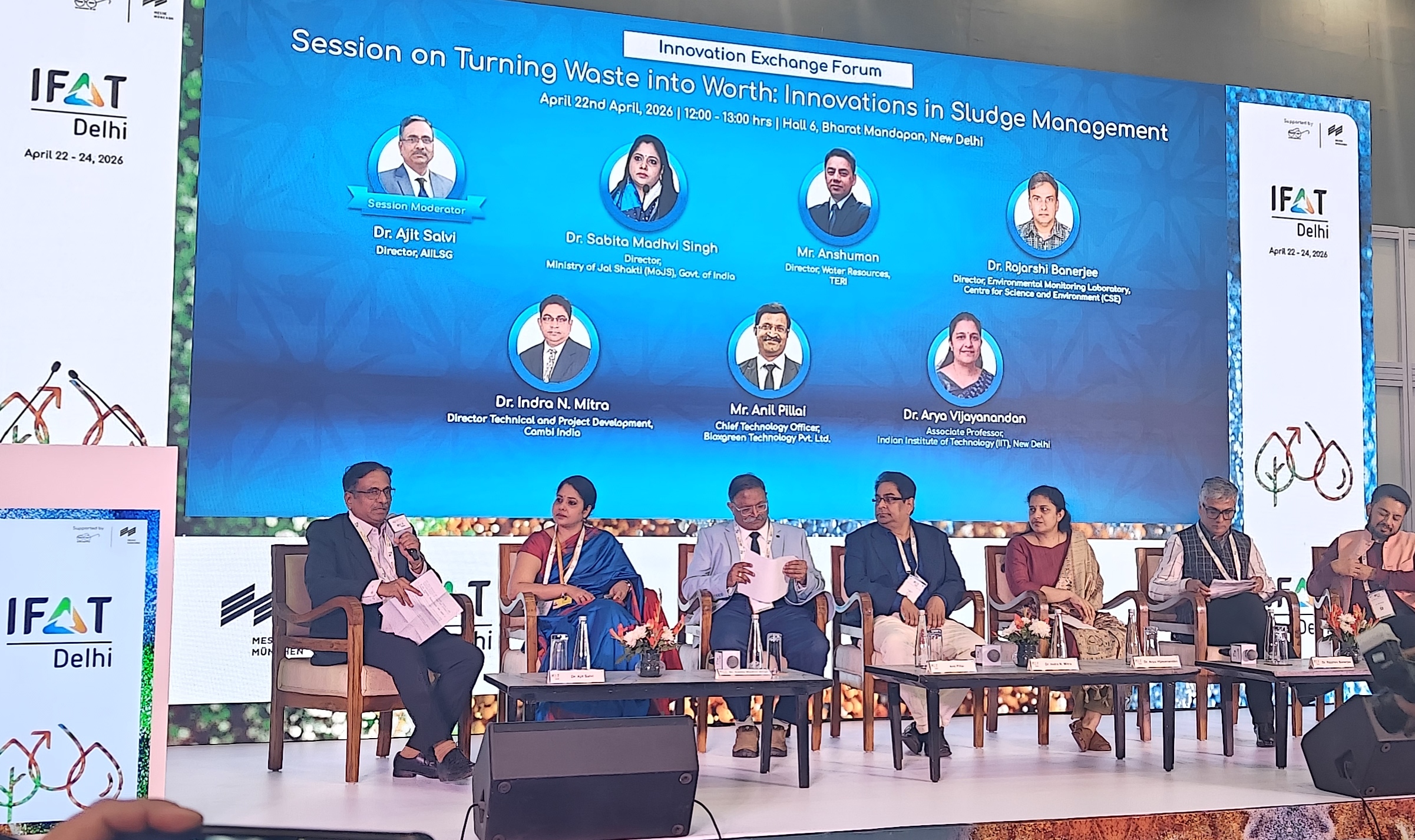
Moderated by Dr. Ajit Salvi, this session was perhaps the most crucial of the day. Sludge, the semi-solid, often toxic by-product of water treatment, is the “elephant in the room” of environmental management. We treat the water, but we are left with a massive problem of what to do with the thick, sludge-laden residue.
The session highlighted several uncomfortable realities:
- ■ The inconsistency problem: The incoming feed for sludge treatment plants is highly inconsistent. A plant might be designed for one type of sludge, only to receive a completely different chemical profile the next day. This variance wreaks havoc on treatment efficiency.
- ■ Quality hurdles: The reuse of sludge is hampered by its composition. Some sludge is rich in phosphoric substances, great for fertilizer, but others are loaded with high levels of nitric oxide or toxic heavy metals. Combining these for a singular “reuse” purpose is not just difficult; it’s dangerous.
- ■ The regulatory vacuum: While there are vague goals for sustainability, we lack specific, granular mandates for sludge management. We don’t have enough standardized protocols or benchmarks that govern how sludge should be classified, tested, and processed across different industries.
However, the session was not just about lamenting these challenges. The proposed solutions centred on a transition toward a value-driven model:
- Standardized benchmarking: The industry needs a universal protocol. If we don’t define what a “safe” sludge is, we can’t market it.
- Economic viability: A major takeaway was the “cost-of-byproduct” trap. If the energy or fertilizer you derive from sludge costs more to produce than the conventional equivalent, no one will buy it. The focus must shift to lowering processing costs through advanced anaerobic digestion and energy-capture technologies.
- Energy harvesting: The panellists were bullish on using sludge as a feedstock for energy. By capturing biogas, we don’t just solve a waste problem; we create a power source that can offset the plant’s operational costs.
Session 2, The India-EU Water Partnership
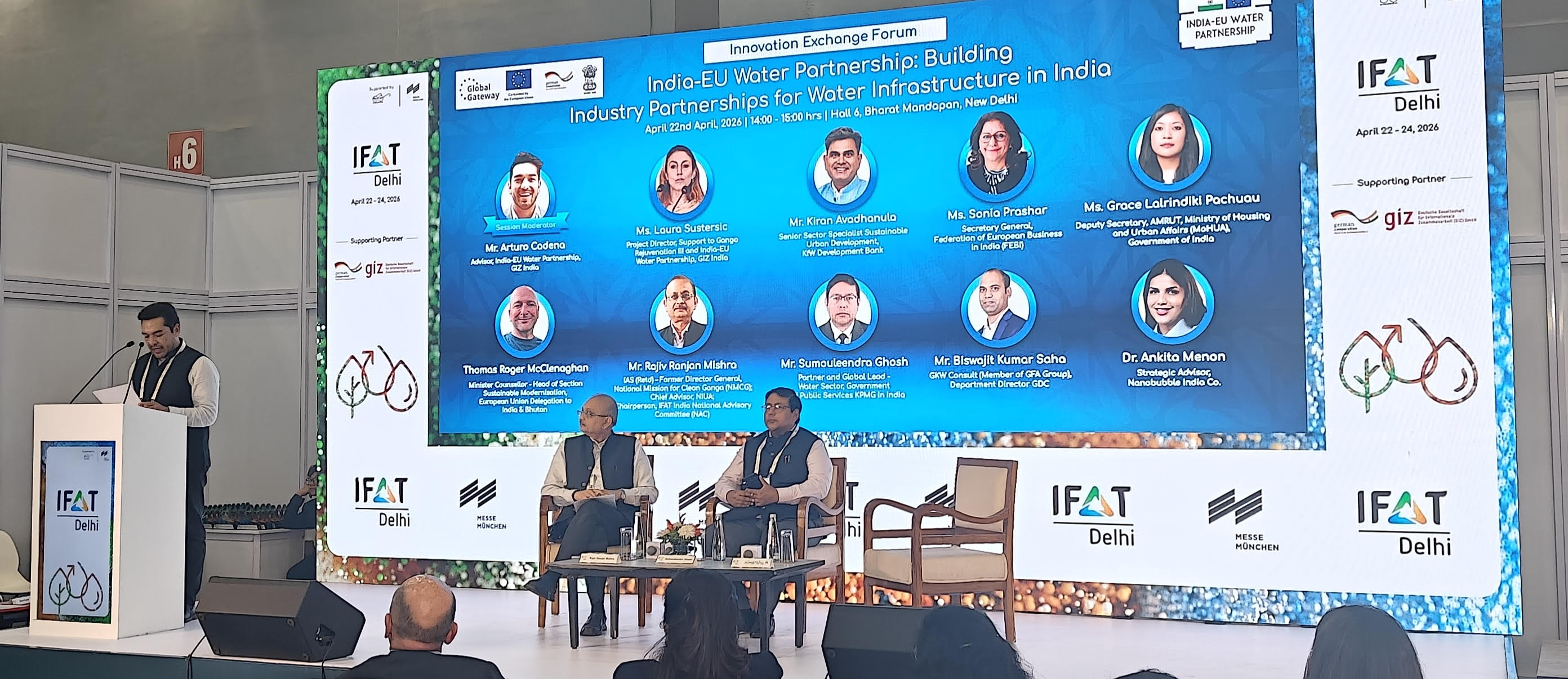
The afternoon session, headed by Mr. Arturo Cadena, shifted the perspective toward macro-governance and international cooperation. This was a deep dive into the strategic vision for water security.
The issues identified for immediate concentration were wide-ranging:
- ■ Water governance & resiliency: With climate change threatening our traditional water sources, “water resilience” is the new mandate.
- ■ The Ganga river basin: Managing one of the world’s most complex river basins requires more than local effort; it requires international expertise in basin-wide governance and pollution control.
- ■ Urban challenges: From the Jal Jeevan Mission to the Urban Challenge Fund (UCF), the focus is on creating scalable, bankable urban water infrastructure.
The partnership with the European Union is not just about technology transfer; it is about policy alignment. The European experience in water governance, when combined with India’s massive scale and need for infrastructure, creates a unique sandbox for innovation. We are seeing a shift toward “Triple P” (Public-Private-People) partnerships, which aim to ensure that water infrastructure is not just built, but maintained and used sustainably by the communities it serves.
The future of water management lies in asset creation that is performance-based. It’s no longer enough to just build a treatment plant; the facility must meet specific efficiency and output benchmarks to receive funding. This performance-linked approach is a game-changer for the Indian water sector.
The Bigger Picture: Why This Matters to You
So, why should the average reader care about IFAT Delhi 2026?
Because we are reaching a tipping point. For years, environmental management was treated as a “social cost”, something we did because we were told to, or to avoid fines. What we saw at IFAT 2026 was the absolute dissolution of that mindset. It is being replaced by an “economic opportunity” mindset.
When a company realizes that their industrial waste, once a disposal liability, can be converted into a product that they can sell, the entire dynamic changes. When a municipality realizes that sludge can be used to generate electricity to power its own lighting, the political will to fund those projects becomes much stronger.
This is the promise of the circular economy. It turns sustainability into a profit centre.
A Beacon of Hope for a Greener Future
IFAT Delhi 2026 served as a vibrant hub of innovation, collaboration, and thought leadership. We are clearly moving toward a future where our water is cleaner, our waste is utilized, and our infrastructure is built to withstand the pressures of a changing climate.
But the success of this vision depends on us, on industries adopting these technologies, on policymakers enforcing the protocols discussed in the sessions, and on the public holding both accountable. The event in Delhi was a spark; the challenge now is to sustain that fire, turning these dialogues into daily practices.
The next time you walk past a public bench or turn on your tap, remember: there is a massive, behind-the-scenes world of engineering and policy working to ensure that resources are handled with the care they deserve. IFAT Delhi 2026 was a window into that world.
How Build to Sustain Can Help
Whether you’re a manufacturer looking to turn industrial by-products into revenue, a municipality evaluating waste-to-energy options, or a board asking how resource recovery fits your ESG strategy, Build to Sustain helps translate these macro shifts into operating plans that work for your business.
Our team benchmarks your performance through the proprietary SIM assessment, maps resource and waste flows across your operations, and aligns disclosures with BRSR, GRI and TCFD so every sustainability investment is measurable and defensible.
Ready to turn the tide for your organisation?

Last reviewed: April 2026