
Understanding EU CBAM compliance: you are not the legal declarant
Under EU CBAM, the legal filer is your customer, not you. The importer in Europe registers as an authorized CBAM declarant, files the declaration, and buys the certificates. Nothing obliges an Indian factory to file directly in Brussels.
What obliges you is commercial. To maintain EU CBAM compliance, your buyer needs verified embedded emissions data for your goods. If you cannot supply it, they must use EU default values, and those defaults are deliberately punitive. Industry analysis puts them 30 to 80 percent above actual production emissions for most Indian producers.
That gap becomes a direct cost on your consignment. Your buyer will either pass it back to you in the contract price or move orders to a supplier who already has the data. This is where practical CBAM consulting turns a compliance headache into a competitive commercial advantage.
Book a consultationWhere EU CBAM compliance stands right now
Checked September 2026. Regulatory timelines and requirements evolve, so use this overview to track your immediate obligations and reporting milestones.
| What | Status | What it means for you |
|---|---|---|
| EU CBAM definitive period | Live since 1 January 2026 | CBAM certificates are now active financial liabilities, not just an administrative exercise. The transitional grace period is officially over. |
| EU de minimis threshold | 50 tonnes per importer per year | Small buyers fall out of scope entirely. High-volume buyers are fully liable, and they are the ones demanding verified installation data from you. |
| First EU declaration and surrender | Due 30 September 2027 for 2026 imports | Your European buyers will need your verified 2026 CBAM reporting data well ahead of this deadline to prepare their filings. |
| Mandatory third-party verification | In force in the definitive period | Emission numbers must be audited by an EU-recognized or ISO 14065 accredited verifier. Self-declared estimates are no longer accepted. |
| UK CBAM | Begins 1 January 2027 | Applies to aluminium, cement, fertiliser, hydrogen, iron, and steel. Glass and ceramics have been excluded from the initial 2027 scope. |
| UK registration threshold | GBP 50,000 of CBAM goods over 12 months | A much lower threshold than most exporters anticipate. If you sell into the UK market at any regular scale, your buyer is in scope. |
| India’s CCTS | Initial compliance filings completed July 2026 | Around 490 obligated entities now hold binding emission intensity targets. If you are covered, this directly impacts your UK and EU carbon price offsets. |
Is your product in scope for EU CBAM compliance?
Both EU and UK mechanisms target key carbon-intensive commodities. If you export any of these materials, or downstream articles manufactured from them, verified CBAM reporting is required to protect your trade volumes.
EU + UK
Iron & steel
The largest CBAM exposure in Indian export trade by value, and the sector where default values hurt most. Includes a growing list of downstream articles, not just primary product.
EU + UK
Aluminium
High electricity intensity means your grid emission factor drives the number. Indian aluminium has already seen measurable CBAM pressure on EU order volumes.
EU + UK
Cement
Process emissions from calcination dominate, so efficiency improvements alone move the figure less than operators expect.
EU + UK
Fertilisers
Nitrous oxide and ammonia feedstock emissions both count. Route matters enormously here.
EU + UK
Hydrogen
Production route is everything. Grey, blue and green hydrogen produce radically different embedded emissions from the same tonne of product.
EU only
Electricity
In EU scope, not in the UK’s 2027 scope. Relevant for cross-border power rather than most manufacturers.
Embedded emissions calculation at the granularity CBAM demands
This is the technical core, and it is where most internal attempts fall short. CBAM does not ask for a company-wide carbon footprint. It requires specific emissions calculated for each installation, each product line, each production route, and each consignment. That requires far deeper technical accounting than domestic frameworks.
- Installation boundary: defining the production installation and its processes the way the CBAM methodology defines them, which is rarely how your plant is organised.
- Direct emissions: fuel combustion and process emissions, measured, not estimated from national averages.
- Indirect emissions: purchased electricity, with the emission factor properly evidenced.
- Precursor materials: embedded emissions carried in your inputs, which means chasing data up your own supply chain.
- Attribution: allocating across products and routes so each consignment carries a defensible figure.
- Verification pack: assembled so an accredited verifier can sign it, because unverified numbers are now worthless.

The carbon price question, where the UK and EU now diverge
Both schemes let you deduct a carbon price already paid at home. Only one of them currently accepts India’s. This is the single most valuable thing on this page, and almost nobody has it right.
UK CBAM: CCTS is recognised
- India’s Carbon Credit Trading Scheme appears on the UK’s list of qualifying overseas carbon pricing schemes.
- That opens Carbon Price Relief: the carbon cost you have already borne in India is subtracted from your UK CBAM charge, so you are not taxed twice.
- The relief is not automatic. You have to show that the producing facility was covered by the mandatory regime, establish the emissions embedded in the specific product, and prove a carbon cost was actually borne against them.
EU CBAM: CCTS is not recognised
- The European Commission’s draft implementing regulation of 13 May 2026 named the UK, China and California. India was not on it.
- The obstacle is definitional. CBAM defines a carbon price as an amount paid as a tax, levy, fee or ETS allowance. CCTS issues tradable credits against intensity targets, which is a different instrument.
- So for now, plan your EU pricing on the assumption that no Indian carbon price is deductible, and treat any future recognition as upside rather than budget.
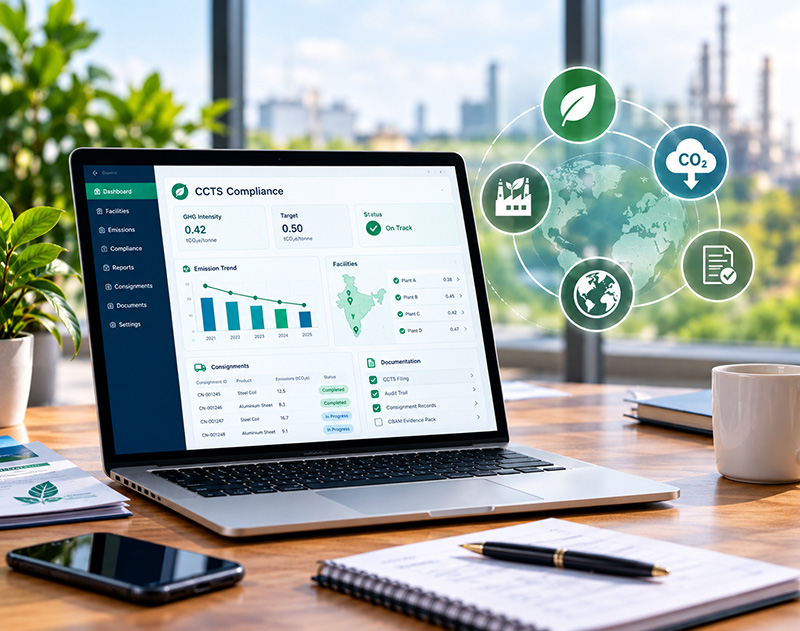
CCTS documentation, and why it is now worth money
Until recently, CCTS compliance was purely a domestic obligation. With the UK recognizing the scheme, the paperwork behind it turns into a deduction against a foreign carbon charge. That changes what “good enough” documentation looks like.
Carbon border measures demand product-level evidence, not a general statement that India has a carbon market. For defensible CBAM reporting, the chain has to connect: this facility, under this obligation, produced this consignment, carrying these emissions, against which this carbon cost was borne.
- Mapping your CCTS obligation and Greenhouse Gas Emission Intensity target to the installations that actually make your export product.
- Building the audit trail from compliance filing through to individual consignment.
- Reconciling CCTS intensity accounting with CBAM absolute embedded emissions, which are not the same measurement.
- Preparing the evidence pack a UK importer needs to claim Carbon Price Relief on your behalf.
How our CBAM consulting services work
Most engagements start when an EU buyer sends a data request nobody in the plant knows how to answer. That is a fine place to start.
01
Exposure check
Which of your products and CN codes fall in scope, for which markets, and which of your customers are the ones who will be asking. Usually finishes in days, not weeks.
02
Data readiness review
What your plant already measures against what CBAM requires. Almost always there is a gap in electricity attribution and precursor data.
03
Embedded emissions calculation
The full installation-level calculation to the CBAM methodology, product by product and route by route.
04
Verification support
We prepare the pack and work alongside your accredited verifier. We do not verify our own numbers, and no credible firm would.
05
Buyer communication
Your figures packaged in the format your EU or UK customer’s declarant can actually use, so it does not bounce back.
06
Reduction planning
Once the number is real, it can be lowered. Where the cost-effective abatement sits, and what it does to your CBAM exposure next year.
Frequently asked questions
Do we have to register for CBAM as an Indian exporter?
No. Registration as an authorised CBAM declarant is your EU importer’s obligation, not yours. For EU CBAM compliance, what you must provide is verified embedded emissions data from your plant. Any consultant telling you that an Indian factory must register directly in the EU has misread the regulation.
What happens if we just do not provide the data?
Your buyer falls back on EU default values, which run roughly 30 to 80 percent above actual production emissions for most Indian producers. They pay for certificates against that inflated figure, and they will either take it out of your price or find a supplier who has the numbers.
Can we calculate embedded emissions ourselves?
You can do the measurement work, and if you have good instrumentation you should. But the definitive period requires independent third-party verification by an EU-recognised or ISO 14065 accredited verifier. Self-declared figures do not pass anymore, which is where our CBAM consulting services help bridge the gap to full audit readiness.
We already do a corporate carbon footprint. Is that not enough?
No, and this is the most common misunderstanding. A corporate footprint is organisation-wide and annual. Official CBAM reporting demands emissions attributed directly to a specific installation, product, production route, and consignment. The underlying data helps, but the calculation is a completely different exercise.
Does India’s carbon price reduce our CBAM bill?
In the UK, yes. India’s CCTS is on the UK’s list of qualifying overseas carbon pricing schemes, so Carbon Price Relief is available if you can evidence it properly. In the EU, not at present. The Commission’s draft implementing regulation of May 2026 named the UK, China and California, and India was not included.
When do we actually need this done by?
Earlier than the published deadlines suggest, because they are your buyer’s deadlines, not yours. For EU CBAM compliance, the first declaration falls due 30 September 2027 for 2026 imports, which means your customer needs verified 2026 figures during 2027 and will start chasing well before that. UK CBAM begins 1 January 2027.
We are a small exporter. Are we below the threshold?
The thresholds apply to your buyer, not to you. The EU exempts importers bringing in 50 tonnes or less a year in total, and the UK sets its bar at GBP 50,000 over 12 months. A small consignment from you can still sit inside a large importer who is fully in scope.
Do you handle EUDR and other EU requirements too?
Yes. Deforestation regulation, supplier due diligence, and buyer ESG questionnaires tend to arrive from the same customers at the same time. Through our wider sustainability consulting engagements, we handle these interconnected requirements together so you are not collecting data twice.
Has a buyer asked you for CBAM data?
Send us the request. We will tell you on the first call whether you can answer it with what you already measure, what is missing, and how long it realistically takes to close the gap.
Book a discovery call