
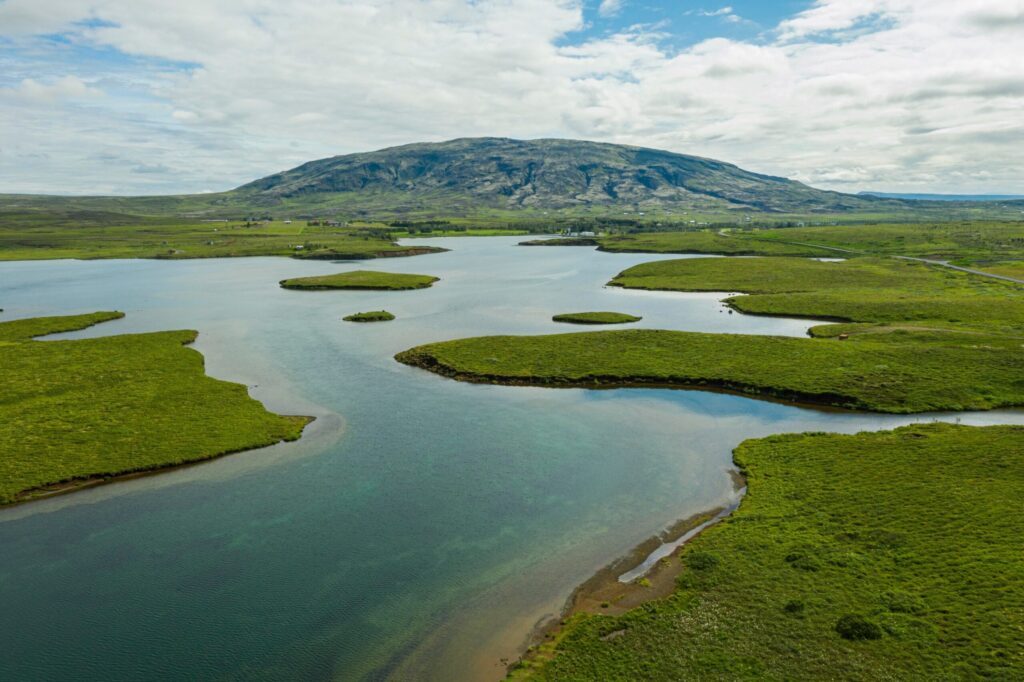
In 2023, scientists floated a 330-square-metre patch of reeds and rushes onto a wastewater lagoon on Phillip Island, Australia. It looked like a modest ecological experiment — roughly one-and-a-half tennis courts of native plants, bobbing on dirty water.
Two years later, the numbers came in, and they’re hard to ignore:
- Methane emissions: down up to 66%
- CO₂ emissions: down up to 36%
- Nitrous oxide emissions: down 18%
- Overall GHG output (CO₂-equivalent): down 22–31%
No new machinery. No plant shutdowns. No massive capital outlay — just plants, roots, and microbes doing what nature does best.
1. The Science, Simplified
Here’s what actually happened, stripped of jargon:
- Researchers from RMIT University, Westernport Water and CSIRO split a wastewater lagoon into two channels — one “treated,” one left as a control.
- The treated channel got the floating wetland, planted with three native species: common reed, jointed rush, and marsh club rush.
- Their roots dangled into the water, creating a cozy micro-habitat for bacteria.
- Those microbes changed how organic waste broke down – releasing far less methane and CO₂ than the untreated lagoon.
- For two full years, sensors logged emissions continuously. Water quality was tested monthly.
The surprising twist: emissions dropped within 4–7 months – long before water quality improvements became measurable (that took a full year). The climate benefit and the water-quality benefit run on different clocks, which matters a lot when you’re designing how to monitor and report these interventions.
Why this matters at scale: wastewater treatment quietly accounts for:
- 1.6% of all human-caused GHG emissions globally.
- 7–10% of global methane and nitrous oxide emissions.
- And methane is 27x more potent than CO₂ over 100 years; nitrous oxide is 273x more potent.
2. Why This Is an ESG Goldmine (Not Just a Science Story)
Investors, regulators and auditors are done with vague “we’re committed to sustainability” statements. They want proof. This study is a masterclass in what proof looks like:
- A control group (so results can’t be dismissed as coincidence)
- Two years of continuous data (not a one-time snapshot)
- Peer-reviewed publication (external validation)
- Quantified outcomes (percentages, not platitudes)
That’s exactly the bar that modern ESG frameworks – GRI, CDP, TCFD, CSRD – are pushing companies toward. If your sustainability report reads like a mission statement instead of a data table, this study is a good reminder of the gap between saying and proving.
3. What It Means for BRSR Compliance in India
If you’re a listed Indian company navigating BRSR (Business Responsibility and Sustainability Reporting), this research is directly relevant:
- BRSR Principle 6 requires disclosure of GHG emissions, water discharge, and the specific actions taken to reduce environmental impact.
- Floating wetlands tick every box regulators want to see:
– Low capex
– No operational disruption
– Quantifiable results
– Monitorable - With assurance requirements tightening for top-listed companies, “we planted some reeds” isn’t a disclosure – a two-year monitored, baselined, peer-reviewed reduction is.
If your company runs effluent treatment plants (textiles, pharma, F&B, pulp & paper — this means you), this is worth putting on the radar.
4. The Bridge to Carbon Accounting and Carbon Credits
This is where environmental science turns into financial strategy.
- Every tonne of avoided methane or CO₂ needs to be captured correctly in your carbon accounting: right scope, right baseline, right methodology.
- The Phillip Island study’s control-channel design is essentially a built-in baseline, the gold standard for calculating “additionality” (proving the reduction wouldn’t have happened anyway).
- Verified reductions like these can potentially feed into carbon credit generation, since wastewater/wetland methane-abatement projects are already recognised under several voluntary carbon market methodologies.
- To be credit-eligible, you generally need:
– Additionality
– A credible baseline
– Ongoing MRV– Monitoring, Reporting, Verification
Why this matters right now: voluntary carbon markets have taken a credibility hit from questionable forestry and avoidance credits. Nature-based, measurable, wastewater-linked projects like this one may offer a higher-integrity alternative – real data, real monitoring, real accountability.
5. Turning a Pilot Into a Corporate Climate Strategy
A single tennis-court-sized wetland is a great case study. Scaling it into an actual business strategy takes more discipline. Here’s the checklist:
- Baseline before you brag. No credible GHG assessment = no credible reduction claim later.
- Build monitoring in from day one. The real value here wasn’t the reeds, it was two years of continuous data logging.
- Design disclosures to do double duty. One well-built data system should be able to feed BRSR reporting, CDP disclosure, and carbon credit documentation simultaneously.
- Treat it as one lever, not the whole strategy. A 22–31% cut in one lagoon is great — but it’s a chapter in your decarbonisation roadmap, not the whole book.
From Isolated Wins to a Real Sustainability Roadmap
Studies like this prove something important: when environmental interventions are designed with measurement built in, the results speak for themselves. But turning one great pilot into an organisation-wide, investor-ready, regulator-proof sustainability strategy? That takes structure.
That’s exactly what Build to Sustain does. We help companies:
- Establish credible GHG baselines through rigorous sustainability assessments
- Identify high-impact, low-disruption interventions tailored to their operations
- Build monitoring and reporting systems that hold up to scrutiny from BRSR to global ESG frameworks
- Structure carbon accounting that’s audit-ready and, where possible, credit-eligible
- Create a clear, actionable roadmap to stay sustainable not just for one reporting cycle, but for the long haul
Environmental ambition is easy. Proving it reliably, year after year – is where Build to Sustain comes in.