

Most hospitals think accreditation ends with patient safety and clinical quality. That assumption is now out of date, and it’s the reason a large share of NABH-accredited facilities in India are about to be caught flat-footed.
Where to start
A gap audit against NABH’s own checklist, run before self-certification is submitted, is the highest-leverage move available to a hospital right now. It identifies exactly where the data doesn’t exist yet, gives the facility time to fix it before it’s on record, and turns a compliance obligation into a genuine baseline for reducing energy, water, and waste costs over time.
Build to Sustain works with NABH-accredited hospitals on exactly this: pre-submission gap audits against the CCRSH checklist, Scope 1–2 emissions inventories built to survive assessor scrutiny, and resilience documentation that holds up when the audit is unannounced. If your hospital hasn’t stress-tested its self-certification data yet, that’s the conversation worth having before the next assessment cycle, not after.
Healthcare occupies a strange position in the climate conversation- it is simultaneously a victim and a contributor. Globally, the sector is responsible for an estimated 4–5% of greenhouse gas emissions- from energy-intensive diagnostics, anaesthetic gases, and medical waste- while also absorbing the rising patient burden of heat stress, vector-borne disease, and air-pollution-linked illness. A hospital that doesn’t measure its own footprint is managing only half of its actual risk exposure.
The regulatory signal hospitals are under-reading
NABH has moved past guidance documents in early 2025. It published a formal Guidebook for Climate Action and Sustainability in Healthcare, complete with a self-assessment checklist, and it offers a complimentary self-certification scheme for Climate Change, Resilience & Sustainability (CCRSH) to accredited and certified hospitals. Complimentary is doing a lot of work in that sentence- NABH is not asking hospitals to pay for a compliance layer, instead, it is removing every excuse not to build one.
Self-certification sounds low-stakes until you read the fine print! It sits inside NABH’s accreditation ecosystem, which is built on surprise, unannounced assessments. A hospital that self-certifies its climate and sustainability posture and then can’t produce the underlying data when an assessor shows up hasn’t avoided scrutiny- it has created a documented gap between claim and evidence. That gap is worse than never certifying at all.
What “monitoring and disclosure” actually requires
Self-certification isn’t a form-filling exercise. To hold up under audit, a hospital needs, at minimum:
- Energy and emissions data: Scope 1 and 2 at a minimum, with metering granular enough to withstand line-by-line questioning, not annualised estimates.
- Biomedical and general waste segregation records: Tied to volumes, not just procedural compliance statements.
- Water consumption and effluent tracking: This is particularly relevant for facilities with in-house dialysis, labs, or sterilisation units.
- Anaesthetic gas and refrigerant management: Such emissions source most hospitals don’t track at all, and assessors are increasingly trained to ask about them.
- A “resilience narrative” : This explains how the facility maintains critical care continuity through heatwaves, flooding, or grid instability, not just an emergency plan on paper.
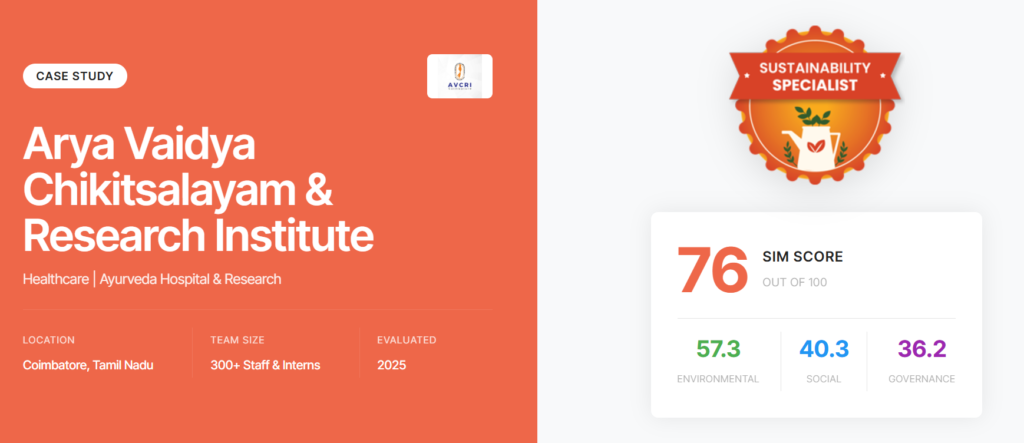
At AVC&RI, sustainability has always been an inherent part of our philosophy, rooted in the Ayurvedic principle of living in harmony with nature. However, translating these values into a structured, measurable, and globally aligned sustainability framework required expertise, vision, and commitment. We are grateful to Aparna Ji and the entire Build to Sustain team for successfully guiding us through this journey.
The team demonstrated a deep understanding of sustainability standards while appreciating the unique operational realities of an Ayurvedic healthcare institution. Through their Sustainability Index Metric (SIM) framework, they provided us with valuable insights into our strengths, opportunities for improvement, and future sustainability goals. Their assessment process was thorough, transparent, and highly collaborative.
What impressed us most was the team’s ability to align our institutional values with globally recognized sustainability principles while preserving the essence of Ayurveda and holistic healthcare. The report they delivered is not merely a document, it is a strategic roadmap that will guide our sustainability initiatives for years to come.
We extend our sincere appreciation to Aparna Ji and the Build to Sustain team for their professionalism, dedication, and unwavering support throughout the process. We would confidently recommend their services to healthcare institutions and organizations seeking to establish credible, impactful, and future-ready sustainability practices
Trustee, AVC&RI
The real cost of waiting
The hospitals most exposed right now are the ones assuming self-certification is a checkbox they can complete close to an audit cycle. That’s backwards! Self-certified data becomes the baseline against which every future assessment is measured- submit weak or incomplete numbers now, and you’ve locked in a low bar that a later, more rigorous audit will expose as inconsistency, not just gaps.
The hospitals that treat this scheme as a genuine measurement exercise by commissioning a pre-submission gap audit, closing the data holes before self-certifying, and building a defensible evidence trail, will walk into their next NABH assessment with a documented sustainability record instead of a liability. That’s the difference between disclosure as a shield and disclosure as an exposure.