
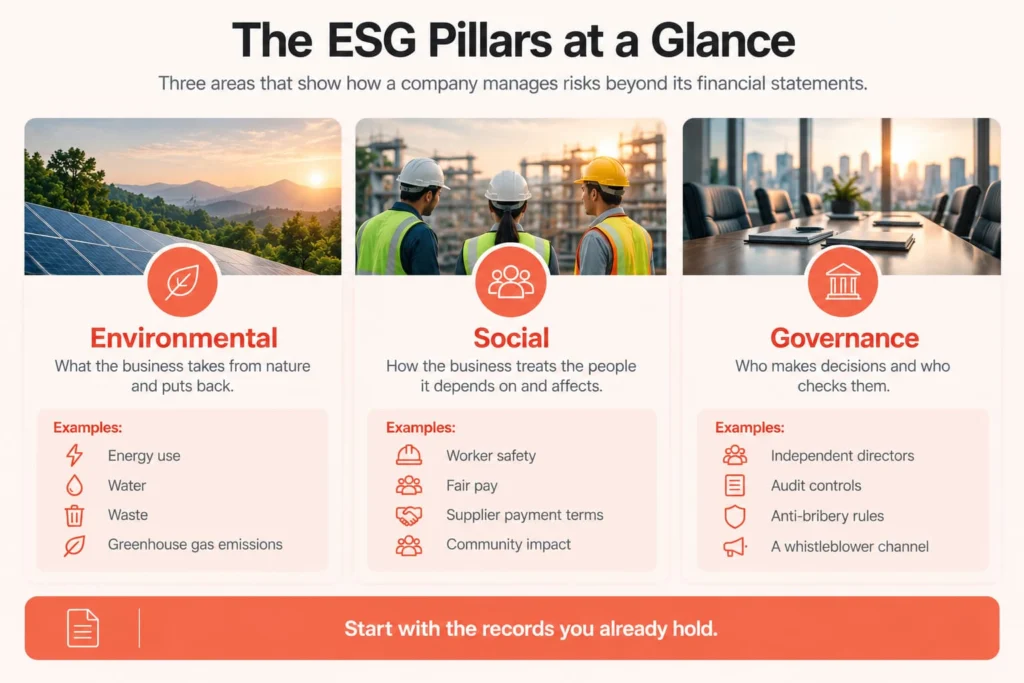
ESG stands for environmental, social and governance. These are the three areas that investors, lenders, buyers and regulators use to judge how a company manages risks that do not appear in its profit and loss account. These ESG pillars examples show what each pillar covers. The environmental pillar covers emissions, energy, water and waste. The social pillar covers workers, suppliers, customers and communities. The governance pillar covers how the company is run and who checks its decisions. Rules in many regions now turn the pillars into reporting duties, from the global ISSB standards to the EU’s sustainability reporting directive and India’s annual disclosures for its 1,000 largest listed companies.
What Are the Three ESG Pillars?
The term ESG first appeared in Who Cares Wins, a June 2004 report produced under the UN Global Compact (a United Nations initiative on corporate responsibility) together with a group of financial institutions. A joint IFC and Global Compact review of that initiative describes its aim: getting environmental, social and governance factors into mainstream financial analysis.
Each pillar answers one question.
For the environmental pillar, it is what the business takes from nature and puts back into it.
For the social pillar, it is how the business treats the people it depends on and affects.
For the governance pillar, it is who makes decisions and who holds them to account.
ESG is often confused with CSR (corporate social responsibility, usually spending on community projects). CSR can be a budget line. ESG shows up in how the factory runs, how the payroll is managed and how the board is built. The pillars also overlap, and most real issues touch more than one.
Environmental Pillar Examples
The environmental pillar covers a company’s effect on climate, water, land and air. It also covers the company’s exposure to those same systems. A plant that depends on groundwater carries an environmental risk even if no regulator has ever fined it.
Most environmental data falls into four groups: energy, water, waste and emissions. Energy is tracked in kilowatt-hours and litres of fuel. Water is tracked as withdrawal, recycling and discharge. Waste is tracked by weight and by destination: recycled, landfilled, incinerated or handled as hazardous.
Emissions have the most structure. The GHG Protocol (the most widely used accounting standard for greenhouse gases, or GHGs) sorts a company’s emissions into three scopes:
- Scope 1: direct emissions from sources the company owns or controls, such as a boiler or a delivery truck.
- Scope 2: indirect emissions from the electricity, steam, heat or cooling the company buys.
- Scope 3: all other indirect emissions across its value chain (its suppliers and its customers), such as raw materials, freight and the use of its products.
Picture a garment factory (a hypothetical example). Its diesel generator and boiler produce Scope 1 emissions. The grid electricity running the sewing lines produces Scope 2. The cotton farming, the dyeing done at outside mills and the shipping to buyers all fall under Scope 3, which is the hardest scope to measure because the data sits with other companies.
One real example: Ørsted, the Danish energy company, reports that it cut the emissions intensity of its own operations (Scope 1 and 2 emissions per unit of energy produced) by 98% between 2006 and 2025. It set its first science-based target in 2017, closed its last coal-fired power station in 2024, and now reports that renewables supply 99% of its energy production. Those are the company’s own figures, but they show how an environmental pillar can become a long-running, multi-year commitment instead of a single project.
For a smaller manufacturer, the first environmental steps are usually plain:
- Put sub-meters on the largest machines or production lines.
- Record fuel purchases by month.
- Separate waste streams at source.
- Ask packaging suppliers whether they can state recycled content.
Social Pillar Examples
The social pillar covers the people a business depends on and affects. That means employees, contract workers, supplier staff, customers and the communities around a site.
Workforce metrics are the most common starting point. These include injury rates, pay against legal minimums, working hours, staff turnover, training hours, and the share of women in the workforce and in management. One widely used safety measure is the lost-time injury frequency rate, which counts injuries that caused missed work per million hours worked.
Beyond the workforce, the pillar reaches outward. A company can track how quickly it pays small suppliers and whether it checks for child or forced labour in its supply chain. It can measure product safety and how it handles customer complaints and personal data. It can also look at local hiring and the effect of noise or effluent on neighbouring villages.
Social data is usually the least organised. It lives in HR files, accident registers and accounts payable ledgers, not in a utility meter that logs readings automatically.
Governance Pillar Examples
Governance is about decision-making and accountability. In a listed company it starts with the board: how many directors are independent (free of business or family ties to the company and its controlling shareholders (called promoters in India)), how the audit committee works, and how executive pay is set. It also covers related-party transactions (deals between the company and its own directors, controlling shareholders or their relatives), anti-bribery rules, a whistleblower channel and oversight of data security.
Governance at a 50-person family business looks different but asks the same question: who can act alone, and who checks them? Are family spending and business spending kept in separate accounts? Does the person who approves a payment also release it? Could a junior employee find a written code of conduct and use it to raise a concern without fear?
Strong governance rarely makes news. Weak governance is often the reason an environmental or social failure grows from a small problem into a crisis.
How Reporting Rules Attach to Each Pillar Around the World
You can understand the pillars without reading a single regulation. You cannot ignore the rules if your company is large, listed or sells to large buyers. Requirements differ by country, so the examples below come from several regions. Check the rules in every country where you operate or sell.
ISSB standards: a global baseline
The ISSB (International Sustainability Standards Board, set up by the IFRS Foundation) issued its first two standards in June 2023: IFRS S1 for general sustainability-related disclosures and IFRS S2 for climate. National regulators decide whether to require them. As of June 2025, the IFRS Foundation counted 36 jurisdictions that had adopted or otherwise used the standards, or were finalising steps toward them, and its chair said new jurisdictions were joining nearly every month. Where a regulator has adopted the standards, listed companies report climate and sustainability risks in this format.
EU: CSRD and what it means for smaller suppliers
The EU’s Corporate Sustainability Reporting Directive (CSRD) was narrowed in 2026. According to the Luxembourg financial regulator CSSF’s summary of the Omnibus package, the directive now covers EU companies and non-EU issuers with more than 1,000 employees and more than €450 million in net annual turnover. Non-EU groups must report only if they earn more than €450 million in the EU and have an EU subsidiary or branch with more than €200 million in turnover, starting with FY 2028.
For a supplier selling to European buyers, wherever it is based, the more useful detail is the “value chain cap”. It limits what large reporting companies can ask of suppliers with no more than 1,000 employees to the information in the VSME standard (the EU’s voluntary reporting standard for smaller companies).
Australia: mandatory climate reporting
Australia’s climate disclosure regime is aligned with the ISSB standards. It phases in by company size, and mandatory reporting for the first group of large entities began for financial years starting on or after 1 January 2025. Smaller entities follow in later phases, so a company’s start date depends on its size and its emissions reporting status.
United Kingdom: modern slavery statements and the social pillar
Under section 54 of the Modern Slavery Act 2015, commercial organisations that carry on business in the UK and have an annual turnover of £36 million or more must publish an annual statement on the steps they have taken against forced labour and human trafficking. The turnover test uses global turnover, not only UK sales, so a foreign company with a UK business can be covered.
United States: audit committees and the governance pillar
Section 301 of the Sarbanes-Oxley Act of 2002, implemented through Rule 10A-3 of the US Securities and Exchange Commission (SEC), directs US stock exchanges to require listed companies to meet audit committee standards, including the independence of committee members. The rule also gives the audit committee direct responsibility for appointing and overseeing the independent auditor. It applies to foreign companies with securities listed in the US as well as domestic ones.
Other markets
Many other countries have their own rules, so check each market you serve. India, for example, has required its top 1,000 listed companies by market capitalisation to file a Business Responsibility and Sustainability Report since FY 2022-23.
Regulations change often. Confirm current requirements with the regulators in each country where you operate (such as the European Commission, the US Securities and Exchange Commission or the Australian Securities and Investments Commission) or with qualified legal counsel before acting on anything above.
Starting Small: ESG Pillar Metrics a Company Can Track Now
A first baseline rarely needs software. It needs a year of records and one named owner.
| Pillar | Metrics to start with | Where the data usually sits |
|---|---|---|
| Environmental | Electricity (kWh), diesel and other fuel (litres), water (kilolitres), waste (tonnes) | Utility bills, fuel purchase records, waste vendor receipts |
| Social | Headcount by gender, injuries and lost days, training hours, supplier payment days | HR files, accident register, accounts payable |
| Governance | Ownership and board structure, written policies, audit findings, complaints received | Company records, statutory audit reports, grievance log |
Collect twelve months of figures before setting any targets, because a target set without a baseline is a guess. Record the source and the unit beside every number, so the next person can repeat the exercise. Where a number is missing, write down that it is missing and why. Gaps are normal in a first year, and a clearly marked gap serves a reader better than an estimate presented as fact.
Where to Go From Here
The pillars give a company three questions to keep asking: what its operations take and release, what it owes its people, and who answers for both. The answers are rarely complete in year one. A basic ESG record built from electricity bills, an HR register and a policy folder is a better start than a long report built on assumptions.
Build to Sustain is an ESG consulting company. More about the company is available at buildtosustain.net. This article is general information, not legal or financial advice.