

Esg Assessment Services
Know exactly where your business stands with an independent ESG assessment
Get an independent, evidence-verified sustainability assessment and ESG score. We assess your operation on site, score it across 19 sub-pillars, and give you a rating you can put in front of a customer, a bank, or an auditor.
What an ESG assessment actually is
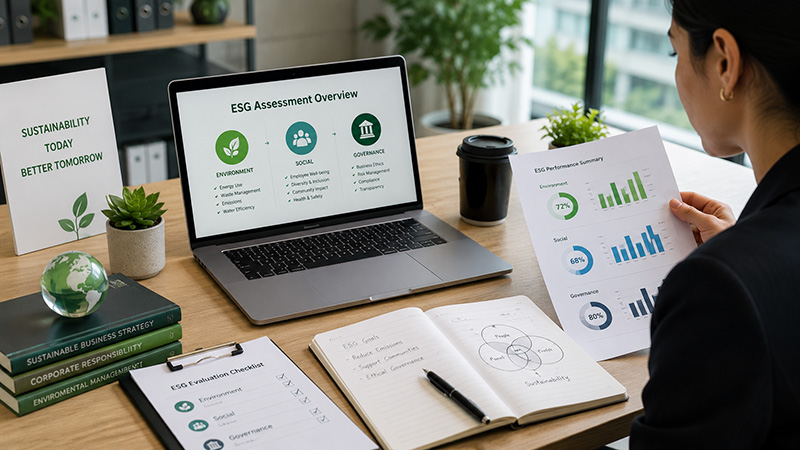
An ESG assessment measures your performance across core ESG metrics in three areas: Environment (energy, water, waste, emissions), Social (worker welfare, safety, training, community), and Governance (ethics, compliance, systems, disclosure). It produces an ESG score, and behind that score, verified evidence.
That last part is what separates a real assessment from a questionnaire. A self-declaration form asks what you do and takes your word for it. An assessment checks against your bills, registers, certificates, what is physically in your waste yard, and what your workers say.
Most companies are already doing more than they get credit for. The problem is that none of it is measured or recorded in a form anyone external will accept. The assessment fixes that.
You are probably here because someone asked you for something
| What happened | What they actually want | Where to start |
|---|---|---|
| A large customer sent an ESG or vendor sustainability questionnaire. | Evidence they can file against their own supply chain disclosure. | Full assessment: it answers the questionnaire and everything after it. |
| You are looking to raise new investment. | A credible ESG position that reduces perceived risk. | ESG assessment with an verified ESG score and an investor-ready summary. |
| You supply a major company needing value chain data. | Specific BRSR data points, to a deadline. | Assessment, then reporting: the data must exist before it can be disclosed. |
| Your bank or NBFC asked for sustainability information. | A credible third-party position, not a brochure. | Assessment with the rating certificate. |
| You export to Europe and carbon or deforestation has come up. | Measured emissions, or proof of origin. | Assessment plus carbon baseline. |
| Your board or promoter wants to know where you stand. | An honest internal baseline before committing publicly. | Assessment, kept private. |
| You want a certification, subsidy or award. | Documentation you do not currently have organised. | Assessment: it produces the evidence file those applications need. |
The SIM framework
SIM stands for Sustainability Index Metric. It is our proprietary framework powering our ESG rating services, and every rating we issue runs on it.
Data is collected in two stages: a scoring set that produces your rating, then a deeper set that supports the report and roadmap. The framework accounts for your sector, your goals, your business model, and the ESG issues most material to your operations.
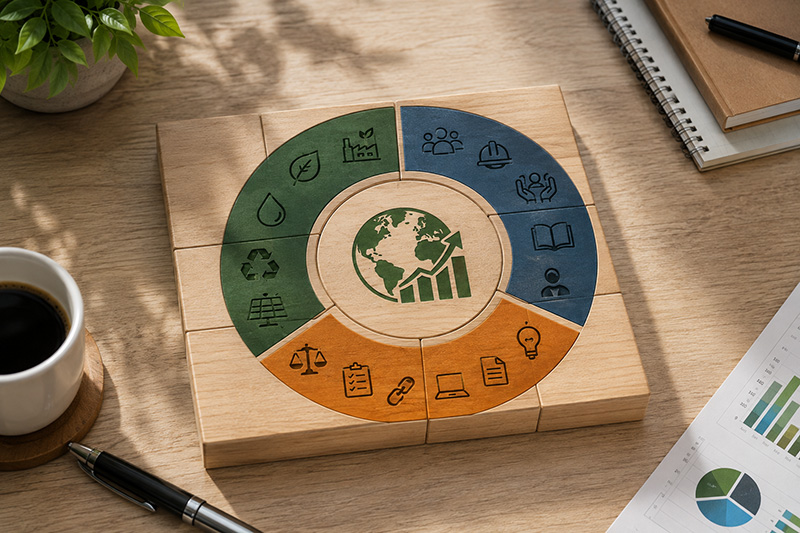
- Environment: Energy, Emissions & Air Quality, Water, Waste, Circularity, Infrastructure, Biodiversity & Land Use.
- Social: Employee Welfare, Occupational Safety, Human Rights, Community, Training & Development, Product Responsibility.
- Governance: Ethics & Anti-Corruption, Regulatory Compliance, Supply Chain Governance, Digital Systems, Reporting & Disclosure, Innovation.
How our ESG assessment works
Seven stages, from first call to handover.
| Stage | What happens |
|---|---|
| Kick-off with discovery call | We meet your single point of contact, explain the assessment and share the document checklist. |
| Desk review | We review your existing policies, bills, registers, certificates and permits remotely, before we arrive. |
| On-site assessment | Facility walkthrough, systems inspection, waste and effluent review, and interviews with team leaders, workers, the facility engineer and procurement. |
| Scoring data collection | Your team enters primary ESG metrics through our platform. We validate the data as it arrives rather than at the end. |
| Scoring | The final SIM ESG score and scorecard are generated, and the rating band is declared. |
| Deep data collection | A second, more detailed data set supports the report and the roadmap. |
| Report & handover | Final analysis, prioritised roadmap, leadership presentation, certificate and evidence index. |
Frameworks our ESG assessment aligns to
| Framework | Why it is in here |
|---|---|
| BRSR and BRSR Core (SEBI) | The Indian regulatory framework. Determines what listed companies and their suppliers must be able to answer. |
| GRI Standards 2021 | The international reporting language most export buyers and global stakeholders expect. |
| ISO 14001 and ISO 45001 | Environmental and occupational safety management systems, widely held in Indian manufacturing. |
| Indian statutory compliance | Consent to Operate conditions, waste rules, EPR obligations, Factories Act. |
| Buyer and supply chain requirements | The recurring content of brand and export customer questionnaires. |
What you receive with our ESG assessment
- Your SIM ESG score, broken down across all sub-pillars, and a rating badge.
- An As-Is Statement Report covering your foundational work.
- A sustainability rating certificate you can share with all stakeholders.
- A scorecard showing exactly where you are strong and where you are exposed.
- A prioritised action plan: what to fix first, what it will take, what it is worth.
- An evidence index, so the next time an auditor asks, the documents are already organised.
- A sustainability report capturing all your efforts (if this service is opted for).

Case study: Manufacturing
Footwear manufacturer, Kozhikode
The organisation
Two units in Kozhikode, producing across EVA, PU, PVC, rubber and textile-based footwear for domestic and GCC markets.
The problem
They were the first vendor in a national brand’s supply chain to be put through a formal ESG assessment. They had strong operational practice on the ground, but almost none of it existed in a form their stakeholders could verify.
What we did
A full SIM assessment across key sub-pillars, with on-site verification of chemical storage, ventilation, PPE use and waste handling, plus interviews across production, HR and facility management.
What came out of it
A verified SIM ESG score with a complete sub-pillar breakdown, a sustainability report, and a prioritised roadmap. One of the clearer findings was how strong their circularity performance already was: production scrap reused, a take-back programme in place, and a shift toward water-based adhesives under way, with none of it previously measured or communicated.
FAQ
Frequently asked questions
Something we have not covered? Ask us directly. A straight answer costs nothing.
Is this an audit?
No. An audit checks you against a standard and issues a pass or fail. An assessment measures where you are and shows you how to improve. That said, we build the output so that when a real audit or assurance exercise comes, most of the work is already done.
We do not have any ESG data. Can we still start?
Yes, and most of our clients start there. Part of our ESG assessment services is setting up the system that produces the data: what to measure, who owns it, and how often it gets recorded.
What if we receive a low ESG score?
Then you have found out privately, before a customer or a lender did. The score is yours. You decide whether to share it. Most companies score in the middle on their first assessment and improve significantly within a year.
Is the rating officially recognised?
The SIM rating is our proprietary framework powering our ESG rating services, mapped to BRSR, GRI, and ISO requirements. It is not a government certification. What it gives you is a credible, evidence-backed answer when a customer, bank, or investor asks how you perform.
How much does it cost?
It depends on the number of sites, your headcount and how much of the data already exists. We scope it after a short discovery call and quote a fixed fee, not an hourly rate.
Do you cover more than one plant?
Yes. Multi-site organisations are assessed facility by facility with a consolidated group-level view on top.
Insights
Related insights

Next step
Find out where you actually stand.
Book a 30-minute discovery call. We will tell you honestly whether a full assessment is the right next step.