Company Overview
BASF India Limited is the Indian operation of one of the world’s largest chemical companies, supplying polyurethane raw materials to the footwear value chain. Its supplied products, ELASTOPAN and ISO systems, total nearly 1.4 million kilograms per year, with raw materials sourced across India, Korea, China, and Germany.
With a workforce exceeding 1,000, BASF India operates at a larger scale than many suppliers in the assessed cohort. Its energy-intensive processes include MDI splitting and prepolymer manufacturing. The company operates comprehensive corporate ESG systems, while the assessment focused on how those systems are implemented and evidenced at the supplying-site level.
The Challenge
Performance. Proof. Recognition
As a global chemicals company supplying quality-conscious customers, BASF India needed its site-level ESG practices captured through a standardised and comparable rating. Corporate-level sustainability claims, however credible at group level, do not necessarily provide the same evidence as a verified, site-specific assessment that a footwear manufacturer’s procurement team can use within its supplier records.
The company’s strengths in safety, water stewardship, and governance were established but had not been independently benchmarked in this specific context. BASF needed an assessment that translated its broader capabilities into local, verifiable evidence.
OUR APPROACH
Evidence. Measure. Benchmark.
Build to Sustain applied the SIM seven-pillar framework, collecting foundational operational data through the Bridge platform and scorable ESG practices through a dedicated questionnaire. Each score was linked to documented evidence and cross-checked between the two data layers.
Because BASF operates at a large scale, the assessment paid particular attention to reconciling site-level operational figures with corporate-level policy claims. Any inconsistencies were flagged for the company to resolve in future assessment cycles rather than being silently accepted or discarded.
EXECUTION
Validate. Rate. Certify.
BASF India completed both data layers. During the assessment, Build to Sustain identified several data points requiring attention: a GHG target response that differed between the Bridge and questionnaire layers, an electricity figure that appeared unusually low for a chemical manufacturing operation, and a blank welfare-benefits field that may have resulted in lost marks. These items were flagged transparently rather than adjusted, reflecting the evidence-first approach of the framework.
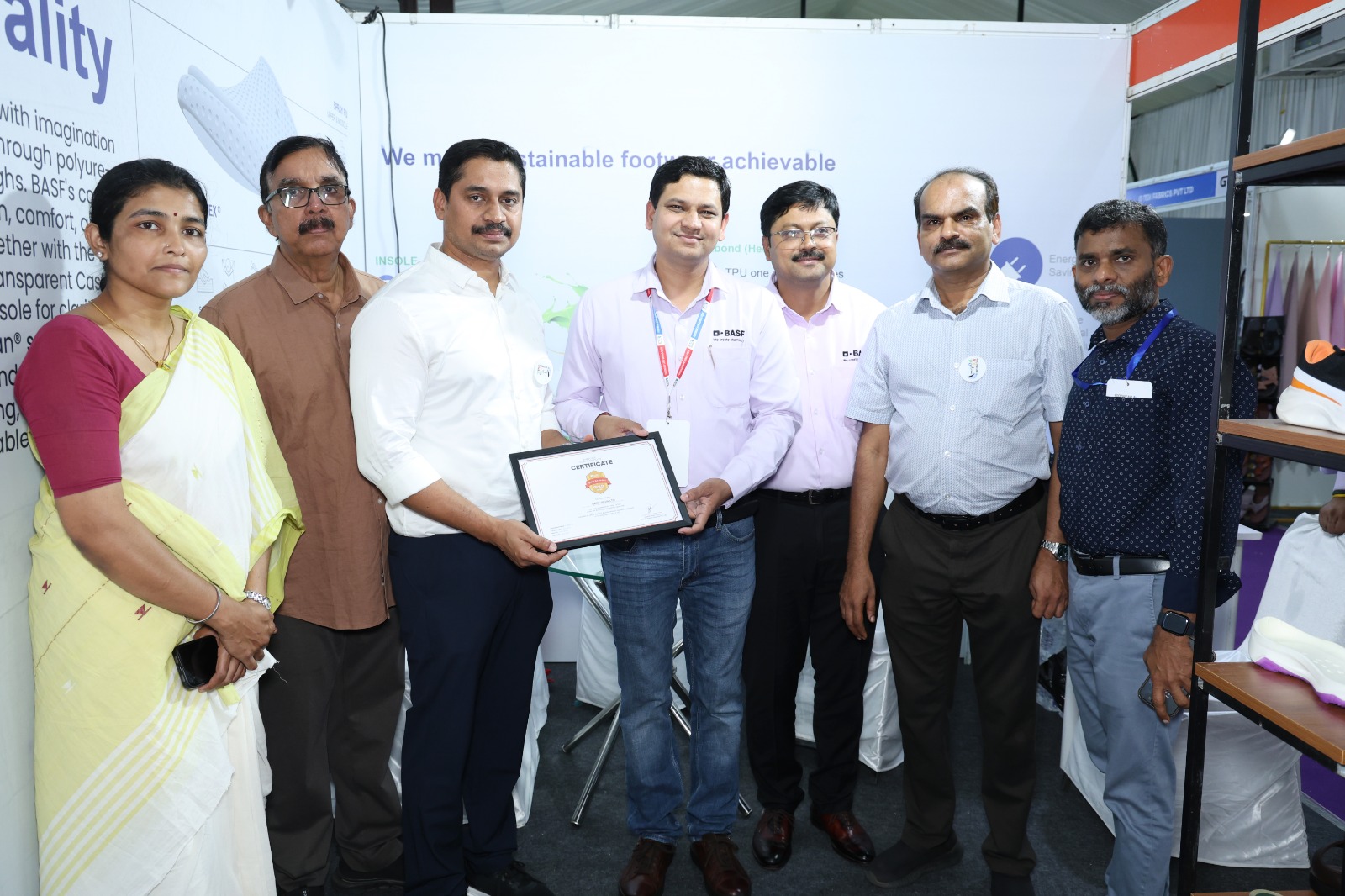
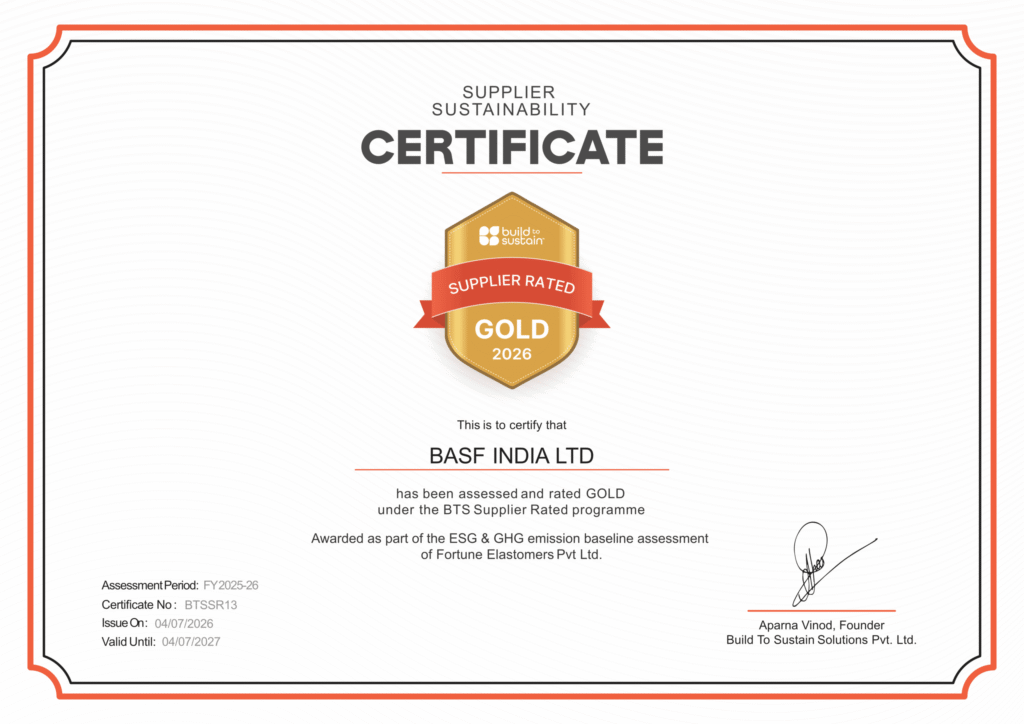
The assessment produced a full scorebook and a Gold-tier certificate, with the identified data items recorded for reconciliation ahead of the next assessment cycle.
EXECUTION
The Assessment in Detail
BASF India was rated Gold with an overall score of 83/100. It achieved perfect scores across four of the seven pillars, while its main opportunities were concentrated in Energy & Climate, Materials & Product, and one social data gap.
Pillar scorecard
| Energy & Climate | Water & Effluent | Waste & Circularity | Materials & Product | Health & Safety | Labour & Social | Governance |
|---|---|---|---|---|---|---|
| 10/15 | 10/10 | 12/12 | 5/13 | 15/15 | 11/15 | 20/20 |
DIMENSIONAL ANALYSIS
Environment 74/100
Perfect scores on Water & Effluent (10/10) and Waste & Circularity (12/12): metering, recycling and reuse, rainwater harvesting, water-reduction targets, authorised hazardous-waste disposal, a formal waste policy, and intensity tracking. Energy trails – solar sits under 5% of consumption and organisation-level GHG emissions are not yet tracked, though reduction targets exist and ISO 50001 energy audits are conducted.
Social 87/100
Health & Safety achieved 15/15, supported by a formal OHS system, zero lost-time injuries, quarterly training and drills, full PPE, on-site first aid, and LTIFR and TRIR tracking. Labour & Social scored 11/15, with the assessment identifying a blank welfare-benefits response and female representation below 10% as areas requiring attention.
Governance 100/100
A perfect governance score built on ISO 14001 and ISO 50001 certifications, product certifications, a Code of Conduct, anti-bribery and whistleblower mechanisms, formal ESG reporting, third-party audits, a designated sustainability team, and data-privacy and business-continuity policies.
STANDOUT STRENGTHS
- Four pillars achieved full scores: Health & Safety (15/15), Governance (20/20), Waste & Circularity (12/12), and Water & Effluent (10/10).
- Health & Safety achieved a full 15/15, supported by zero reported lost-time injuries and documented metric tracking.
- Comprehensive water stewardship and waste governance, underpinned by ISO 14001 and ISO 50001 certification.
Improvement Roadmap
The assessment translates into a prioritised set of next steps — the fastest, highest-impact routes to a stronger rating:
| Focus area | Recommended action |
|---|---|
| Energy & Climate (10/15) | Begin organisation-level GHG emissions tracking and expand the renewable-energy share beyond 5% to strengthen Energy & Climate performance. |
| Materials & Product (5/13) | Advance product-level carbon footprinting and Life Cycle Assessment, and raise recycled/bio-based content above its current under-5% level. |
| Data reconciliation | Resolve the flagged inconsistencies (GHG-target response, electricity figure, welfare-benefits disclosure) to ensure the next assessment reflects the company’s true position. |
Key Takeaways
- Advance product-level carbon footprinting and Life Cycle Assessment, and increase recycled and bio-based material content from its current level of below 5%.
- The pathway to Platinum is well defined: organisation-level GHG tracking, more renewable energy, and product carbon footprinting / LCA.
- The assessment also served a quality-control function, surfacing data inconsistencies for the company to reconcile.