Company Overview
Rymbal Pvt Ltd manufactures polyurethane prepolymer and masterbatch systems for footwear and industrial applications, supplying three main products that total more than 800,000 kilograms annually. Its raw materials include monomeric MDI, sourced from Korea, Japan and China, and polyether polyol, sourced from China and Thailand.
The company has 110 permanent employees and 50 contract staff. Rymbal consumes approximately 1.5 million kWh of electricity annually and uses natural gas and diesel. Its sustainability practices include quarterly GHG tracking through an external partner since 2022 and ISCC certification.
The Challenge
Performance. Proof. Recognition
Rymbal had genuine, distinctive ESG credentials – quarterly GHG tracking through an external partner since 2022, and recent ISCC certification – but no single rating that packaged them into a form customers could quickly assess. Its strengths were real but scattered across different systems and partners; a benchmarked rating would consolidate them into one credential.
The company also wanted an honest external read on where its genuine strengths ended and its gaps began – particularly around renewable energy and formal targets – to prioritise its next investments.
OUR APPROACH
Evidence. Measure. Benchmark.
Build to Sustain assessed Rymbal across the SIM framework’s seven pillars, verifying its GHG-tracking arrangement, ISCC certification, and supplier-screening practices against evidence. The two-layer data collection captured both operational figures and scorable practices.
EXECUTION
Validate. Rate. Certify.
Rymbal completed the assessment and provided evidence of quarterly Scope 1 and Scope 2 GHG tracking, conducted with an external partner since 2022. It also provided evidence of ISCC certification and active screening of raw-material suppliers for ISCC compliance.
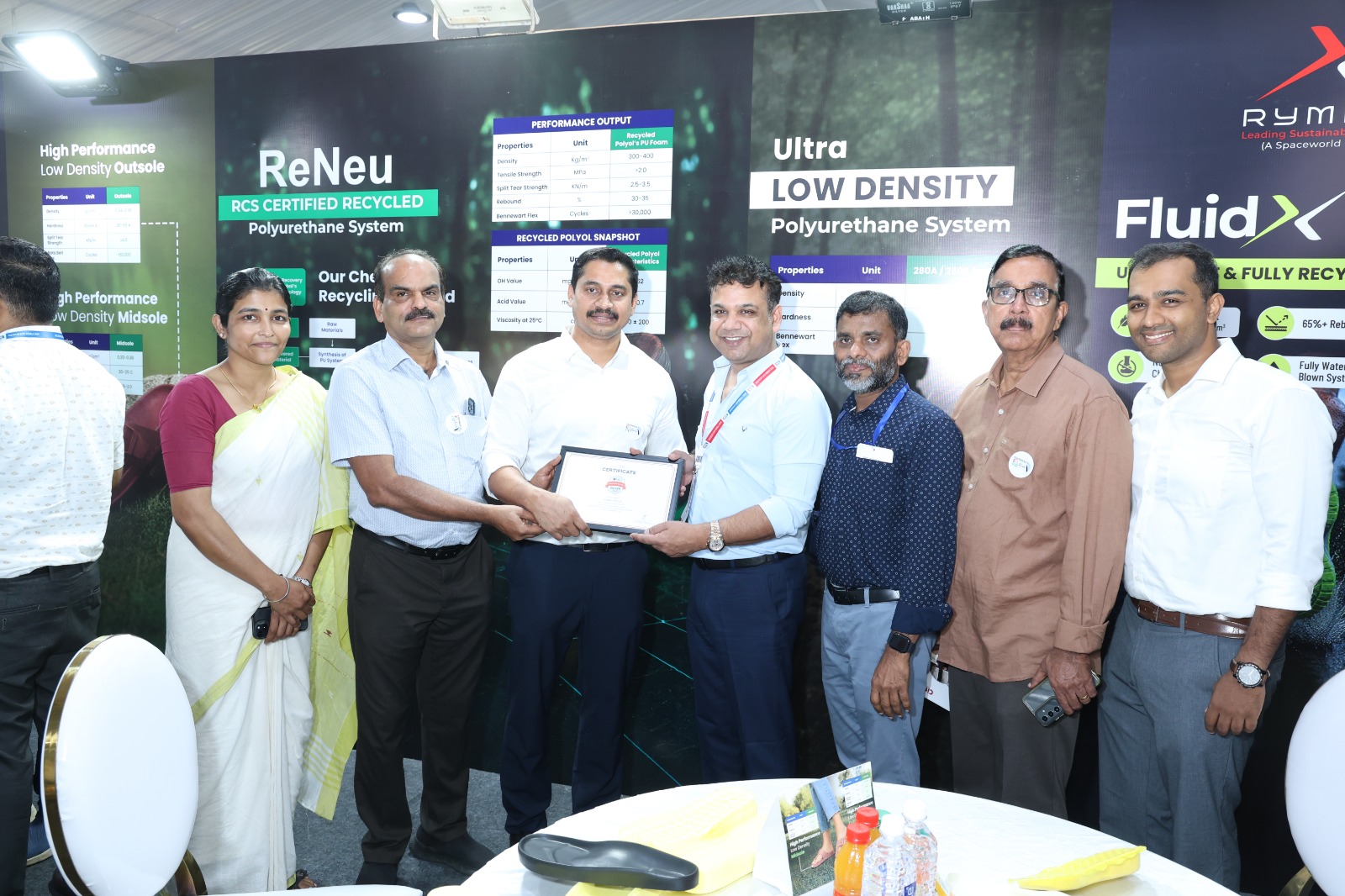
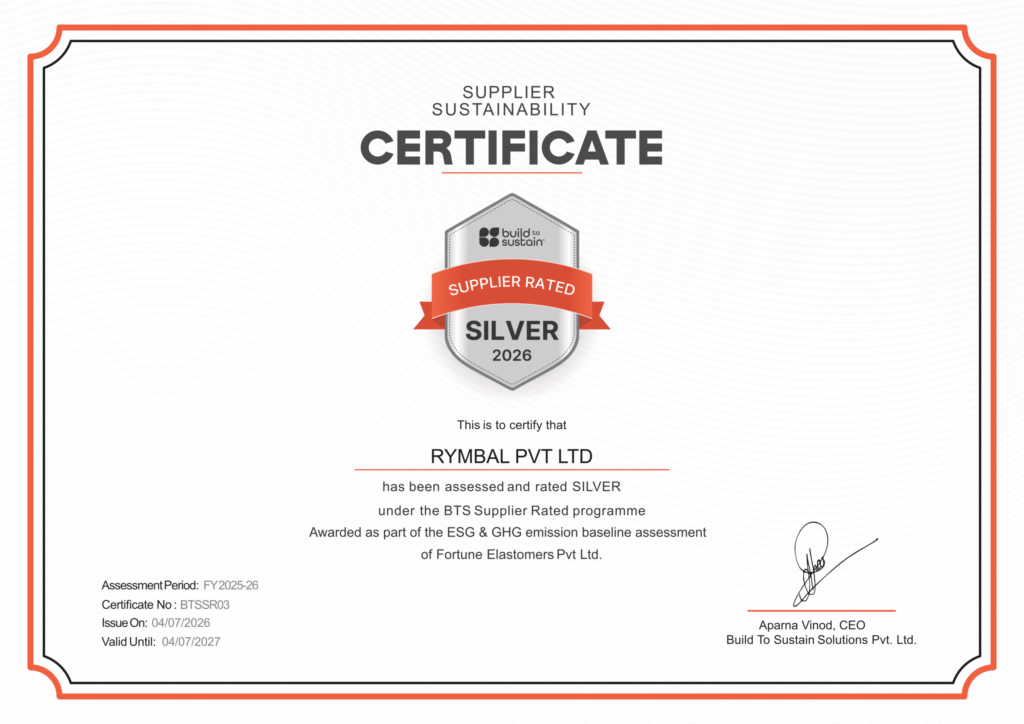
The result was a full scorebook and a Silver-tier certificate.
EXECUTION
The Assessment in Detail
Rymbal was rated Silver with an overall score of 64/100, fourth in the cohort and the sole supplier in the Silver band. Its scores were notably balanced across environment and social, with governance its strongest dimension.
Pillar scorecard
| Energy & Climate | Water & Effluent | Waste & Circularity | Materials & Product | Health & Safety | Labour & Social | Governance |
|---|---|---|---|---|---|---|
| 8/15 | 8/10 | 9/12 | 5/13 | 9/15 | 9/15 | 16/20 |
DIMENSIONAL ANALYSIS
Environment 60/100
Quarterly Scope 1+2 GHG tracking (with an external partner since 2022), an approximately 80% waste recovery rate, a formal waste policy, water metering with daily monitoring, and recent ISCC certification. Renewable-energy share is not yet quantified and formal energy audits are pending.
Social 60/100
A formalised OHS system with an annual training calendar covering every risk subject, full PPE, annual fire drills, on-site first aid, and a digital grievance mechanism via HRM software. Community engagement includes tree-planting (1,000 trees in three years) and education initiatives.
Governance 80/100
ISO 14001 certification, a Code of Conduct and anti-bribery policy, internal ESG reporting, a designated sustainability lead, and a documented set of 32 organisational policies including data privacy.
STANDOUT STRENGTHS
- Quarterly Scope 1 and Scope 2 GHG tracking in partnership with an external group since 2022.
- ISCC certification and active screening of its own raw-material suppliers for ISCC compliance, with R&D underway on bio-based alternatives.
- A high (~80%) waste recovery rate and strong governance documentation (16/20).
Improvement Roadmap
The assessment translates into a prioritised set of next steps — the fastest, highest-impact routes to a stronger rating:
| Focus area | Recommended action |
|---|---|
| Energy & Climate (8/15) | Quantify the renewable-energy share, commission formal energy audits, and set science-based (SBTi-aligned) reduction targets to build on the existing GHG-tracking foundation. |
| Health & Safety (9/15) | Move from annual to more frequent safety training and drills, and begin tracking formal safety metrics (LTIFR/TRIR). |
| Materials & Product (5/13) | Progress the bio-based R&D into measurable recycled/bio content and pursue product carbon footprinting. |
Key Takeaways
- Rymbal earned Silver, distinguished by GHG-tracking maturity and ISCC certification rare at its scale.
- The pathway to Gold runs through renewable-energy quantification, formal energy audits, and SBTi-aligned targets.
- The rating consolidates Rymbal’s already-strong but scattered credentials into one benchmarked credential.