
Company Overview
Huntsman International (India) Pvt. Ltd. is the Indian arm of a global specialty chemicals manufacturer, supplying blended polyol systems for footwear and industrial polyurethane applications. Its two flagship products supplied into the footwear value chain, DALTOPED and SUPRASEC, have combined annual volumes exceeding 1.2 million kilograms.
The operation includes 128 permanent employees supported by 160 contract workers, with continuous chemical-processing lines whose energy-intensive activities include MDI splitting and prepolymer manufacturing. As part of a multinational group, Huntsman operates within established corporate systems for governance, safety, and environmental management. However, these systems had not previously been independently assessed at the India-operations level in a standardised format suitable for customer-facing ESG evaluation.
The Challenge
Performance. Proof. Recognition
Huntsman supplies manufacturers whose ESG commitments increasingly extend to their supplier networks. Customers increasingly expect suppliers to provide evidence such as emissions data, safety statistics, certifications, and documented policies rather than relying solely on general sustainability commitments.
Huntsman had established practices covering emissions tracking, energy efficiency, water recycling, and governance, but it lacked a single, independent, benchmarked assessment that consolidated these practices into a standardised supplier rating.
The opportunity was therefore to make existing ESG practices measurable, comparable, and easier to communicate.
OUR SOLUTION
Evidence. Measure. Benchmark.
Build to Sustain assessed Huntsman using the Sustainability Index Metrics (SIM), a seven-pillar ESG framework covering Environmental, Social, and Governance dimensions and scored out of 100. The assessment followed an evidence-first approach. Scores were supported by documented evidence, including registers, monitoring reports, certificates, and policies, rather than relying solely on declarations.
Data was collected across two layers: foundational operational data through the BTS Bridge platform, covering products, energy, fuel, waste, water, and transport, and a dedicated ESG questionnaire capturing additional scorable practices.
Scoring combined binary assessment for practice-based questions with graduated bands for quantitative metrics such as renewable energy share and lost-time injury frequency. Gating logic ensured that genuinely non-applicable criteria did not negatively affect the assessment.
EXECUTION
Validate. Rate. Certify.
Huntsman completed both data layers and provided supporting evidence for its claims. The assessment covered all seven pillars and cross-referenced Bridge operational data with ESG questionnaire responses to assess consistency.
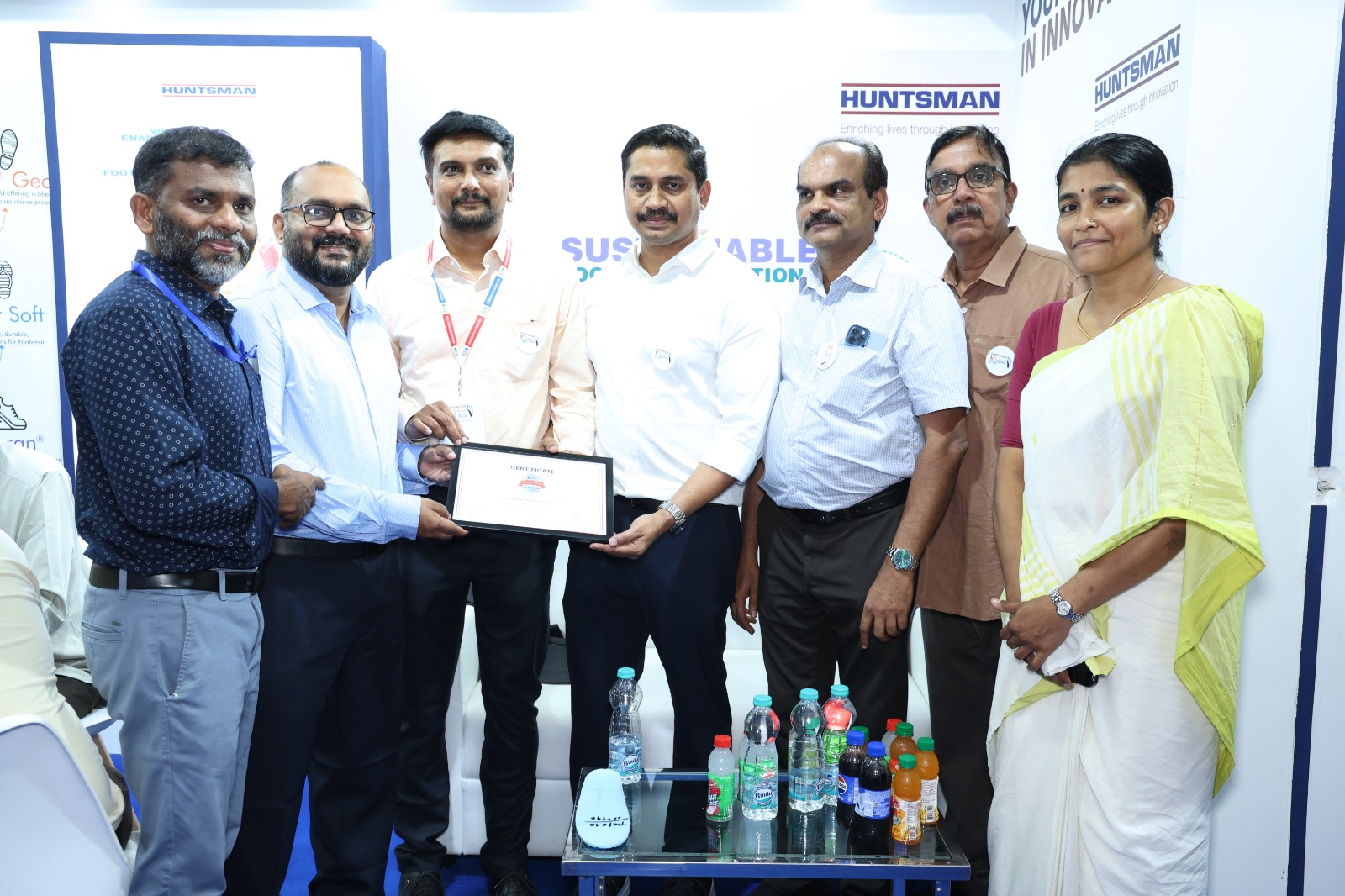
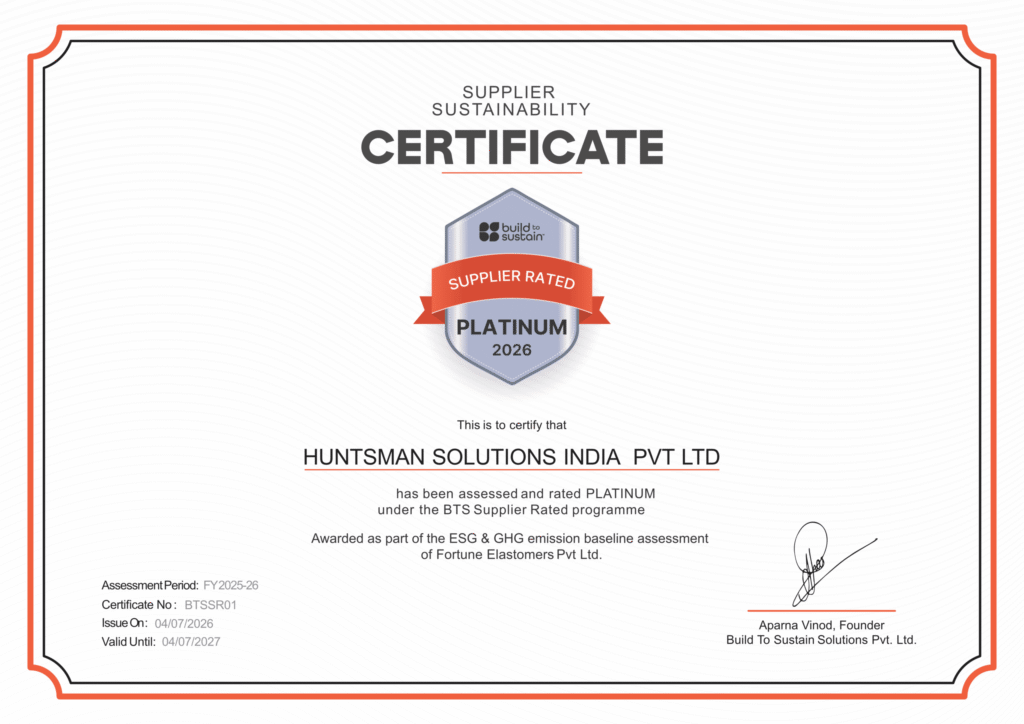
The output was a complete BTS Supplier Rated scorebook covering the overall score, three dimension scores, pillar-level results, product profile, and ESG highlights. A formal certificate was then issued reflecting the awarded tier.
EXECUTION
The Assessment in Detail
Huntsman received a Platinum rating with an overall score of 91/100, placing it in the highest tier of the SIM supplier framework. The assessment showed strong performance across the three ESG dimensions, with Materials & Product representing the clearest opportunity for further improvement.
Pillar scorecard
| Energy & Climate | Water & Effluent | Waste & Circularity | Materials & Product | Health & Safety | Labour & Social | Governance |
|---|---|---|---|---|---|---|
| 13/15 | 10/10 | 11/12 | 8/13 | 14/15 | 15/15 | 20/20 |
DIMENSIONAL ANALYSIS
Environment 84/100
Formal GHG tracking with reported Scope 1+2 emissions, energy-efficiency initiatives including LED programmes and LNG-powered transport, energy audits, water recycling via an on-site STP, and rainwater harvesting. Full marks on Water & Effluent (10/10).
Social 97/100
The social assessment identified strong occupational health and safety practices, including a formal OHS management system, monthly safety training, PPE coverage, documented emergency and fire-drill procedures, on-site first aid, and LTIFR and TRIR tracking. Labour & Social received a full 15/15.
Governance 100/100
A perfect governance score: a written Code of Conduct, anti-bribery and whistleblower mechanisms, formal ESG and sustainability reporting, third-party audits, a designated sustainability function, data-privacy and business-continuity policies, and product certifications.
STANDOUT STRENGTHS
- Governance: 20/20, supported by formal policies, reporting, compliance mechanisms, and oversight systems.
- Formal Scope 1+2 GHG tracking, energy audits, and a suite of implemented efficiency initiatives.
- Complete water stewardship: metering, STP-based recycling, reuse for irrigation, and rainwater harvesting (10/10).
- Responsible waste management including authorised hazardous-waste disposal, a formal waste policy, intensity tracking, and container-reuse circularity (11/12).
Improvement Roadmap
The assessment identified the following priority actions for further improvement:
| Focus area | Recommended action |
|---|---|
| Materials & Product (8/13) | Expand recycled and bio-based content in products, and complete product-level carbon footprinting and Life Cycle Assessment — the clearest single opportunity to lift the environmental dimension further. |
| Renewable energy | Grow the renewable-energy share of total consumption beyond its current early stage to consolidate the environmental score. |
| Certifications | Formalise ISO 14001 and ISO 45001 to convert already-strong environmental and safety practices into externally certified systems. |
Key Takeaways
- Huntsman earned Platinum — the highest tier — validating a mature ESG profile across all three dimensions.
- The rating gives Huntsman an independent, defensible credential to share proactively with the customers who now ask ESG questions
- Even at benchmark level, the assessment identified a concrete growth path: materials circularity, renewable energy, and formal ISO certification